The inherited heart risk a normal cholesterol report can hide
There is a visitor every cardiologist in India knows. I meet him, in some version, every month.
He is forty-eight. He does not come because he is unwell. He comes because of a date. His father died at fifty-two, on the platform of a railway station, of a heart attack no one saw coming. His uncle went at fifty-six. Every year since, on that same day, he has performed his father’s tithi — the anniversary rites a son owes his parents, the priest chanting, the family gathered, the offerings made.
He knows the date the way other men know their children’s birthdays.
And each year the arithmetic gets shorter: he is closing in on the age his father never passed.
He brings his annual health check, and it is immaculate. Cholesterol: normal. Blood pressure: normal. Sugar: normal. He walks an hour a day. He gave up smoking years ago, if he ever smoked at all. The report says, in green, that he is fine.
His father’s reports were normal too.
This man is living inside a dilemma that medicine built for him. If he trusts the green report, he is gambling that he is different from his father, which is exactly the bet his father lost. If he trusts the family history, he becomes a patient without a disease — sleeping badly, reading every twinge in his chest as a verdict, asking for scan after scan that shows nothing and settles nothing. Fear or denial. Those are his options, and the annual checkup cannot choose between them, because the standard panel never measured the thing that killed his father.
That thing has a name. Lipoprotein(a) — said “L-P-little-a” — and it is the most consequential number in cardiology that almost no one has ever had checked.
A number you inherit, not earn
Nearly everything on a lipid report answers for how you live. Eat differently and your LDL shifts. Walk daily, and your HDL creeps up. The report is, in a rough way, a mirror.
Lp(a) is not a mirror. It is an inheritance.
Chemically, an Lp(a) particle is an LDL particle — the “bad cholesterol” you already know — with an extra protein stitched to its surface, a long coiled tail called apolipoprotein(a). That tail makes a bad particle worse twice over. First, the particle burrows into artery walls and builds plaque the way LDL does — the soft, unstable plaque I have written about before. Second, the tail resembles the protein your body uses to dissolve blood clots. It resembles it closely enough to jam the machinery. So Lp(a) helps build the plaque, and then helps keep the clot that forms when the plaque ruptures.
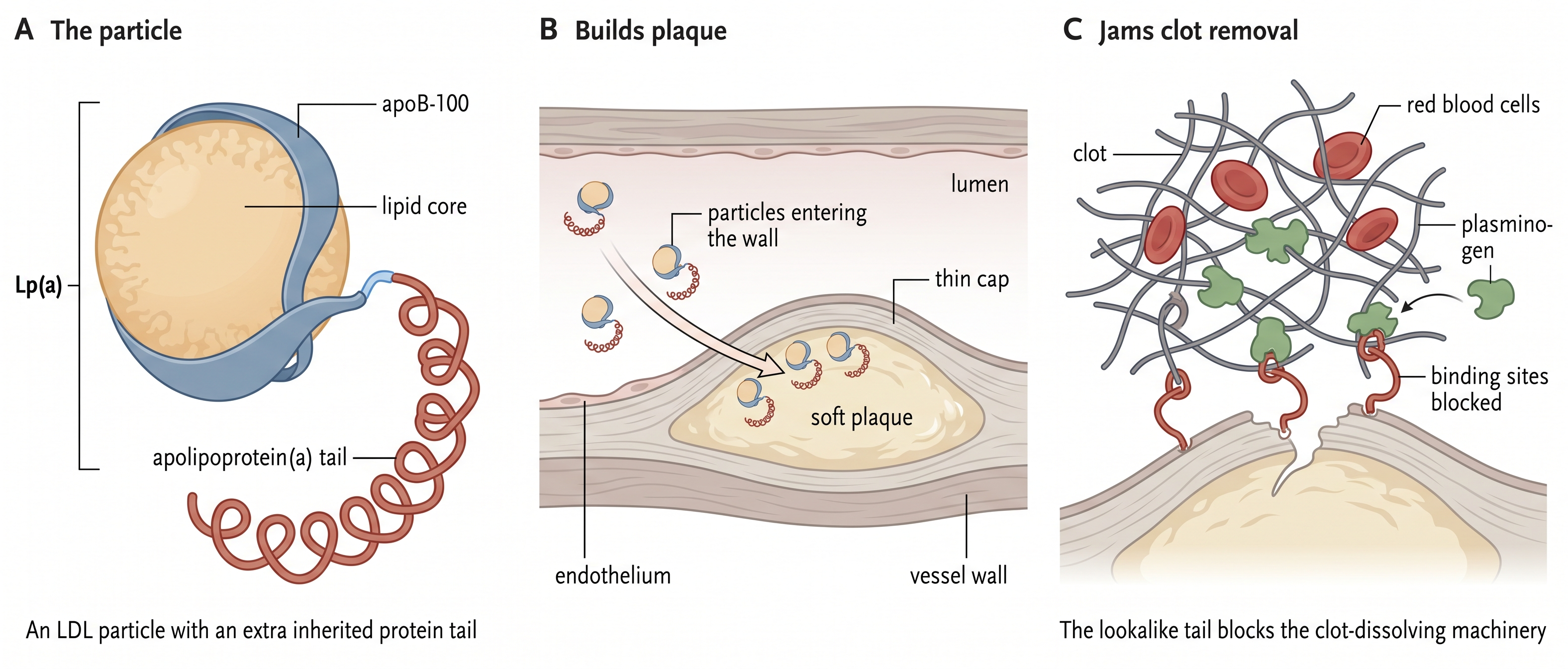
And here is the part that matters for the man with the date: his genes set the level. It is fixed at conception and barely moves for the rest of his life. Diet does not lower it. Exercise does not lower it. Statins do not lower it. He cannot earn a better number, and he did nothing to earn a bad one. Roughly one person in five carries an elevated level. It runs higher, on average, in South Asian blood — one more reason our heart attacks come a decade early.
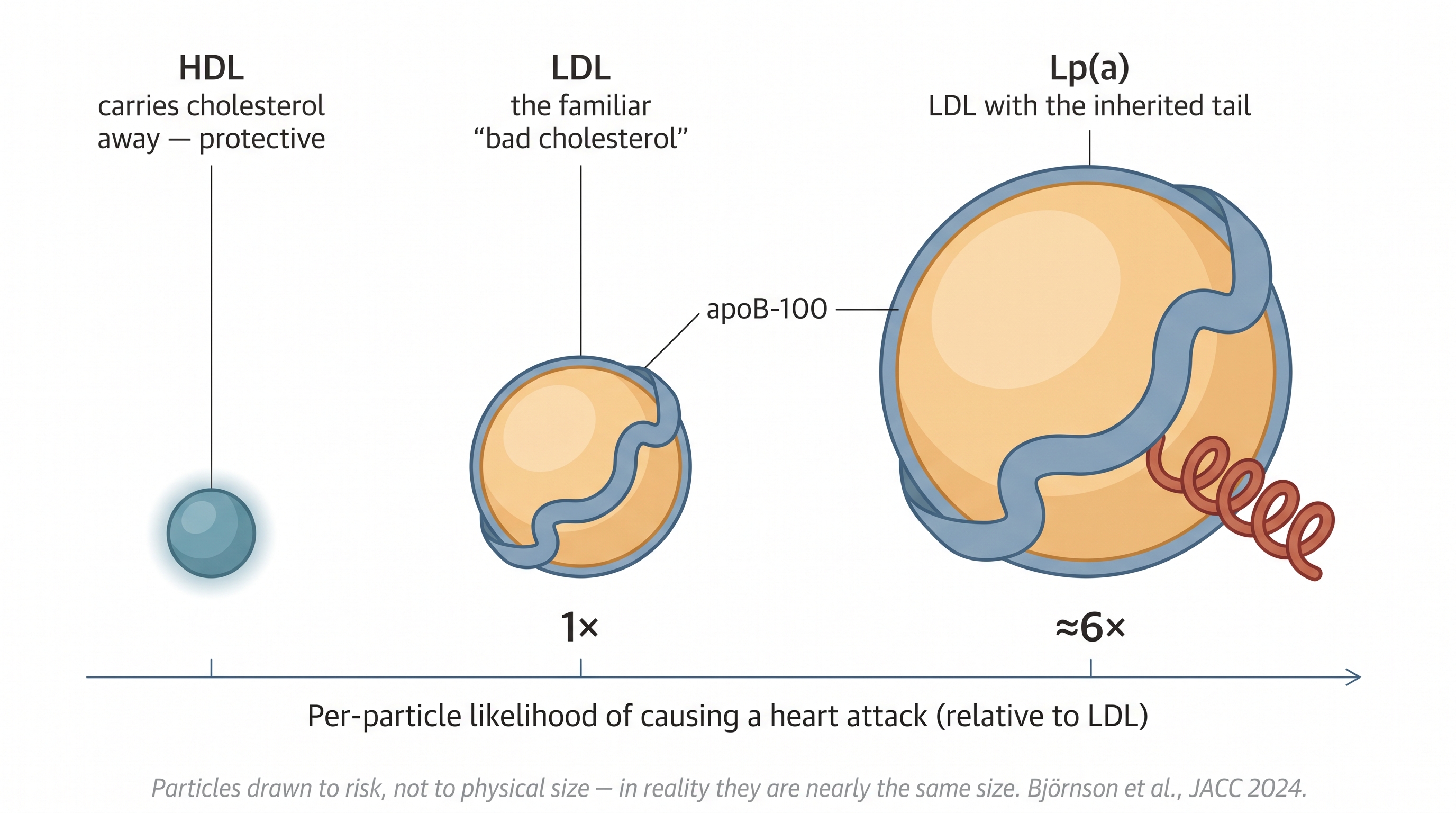
For decades, medicine’s logic for ignoring it was almost reasonable: we had no drug to lower it, so why measure it? We measured what we could treat and called the report complete. Families like his were left with a pattern and no name — “it runs in the family,” said with a shrug, as if that were an explanation and not a confession that we had stopped looking.
The Test That Cannot Lose
The dilemma this man carries — fear or denial, with no way to choose — is resolved by a single tube of blood. Once. Not annually. The number does not change, so one honest measurement lasts a lifetime.
The test cannot lose. It arms him, or it frees him.
If his Lp(a) is high, the family pattern finally has a name, and a name changes everything. Not because we can drug the number itself — the first therapies built to lower Lp(a) are in late-stage trials, and I want them to succeed — but because knowing it rewrites the rules for everything we can treat.
His LDL target drops, and drops seriously: the risk his genes impose, we compensate for with the risks he can shed. His blood sugar and blood pressure get treated like the loaded weapon they are. And the knowing cascades. His brother should be tested. His children should be tested — they can know at twenty-five what he learned at forty-eight, decades before it matters most.
If his Lp(a) is normal, something quieter and just as important happens. The dread loses its object. What he inherited from his father was grief, not destiny. He is an ordinary man with ordinary risks, entitled to ordinary vigilance — the yearly numbers, the daily walk — and to stop rehearsing his own death at every flight of stairs.
Either way, the report finally means what it says. The test cannot lose. It arms him, or it frees him.
This is why the newest International guideline — the same 2026 document that tightened how we treat cholesterol — now recommends that every adult have Lp(a) measured once in a lifetime. Not the worried. Not the bereaved. Everyone, once. It is a Class I recommendation, the strongest language a guideline can use. Against that stands the present reality: fewer than two people in a hundred have ever been tested.
One Line On The Request Form
I have written here about arteries that look healthy while they prepare to kill, and about the pill people refuse because of side effects that mostly are not real. This is the third way a heart hides its intentions: a risk that no mirror shows, because it was never about how you live.
So the ask, this time, is small. The next time blood is drawn for a cholesterol test — yours, your father’s, your brother’s — have one line added to the request form: Lipoprotein(a). It is a routine draw from the same needle, and you will never need it again.
If you live in Bangalore, get the test done at Anand Labs. I got my test done there.
The man with the date will sit for his father’s tithi again this year, as he should. But there is a difference between observing an anniversary and rehearsing one. He does not need another reassurance he cannot believe. He needs the number his father never got. Ask for it once.
Then the prayers can be for the departed — and not, quietly, for yourself.
First 90 Minutes
A deep essay on hearts, AI, and what it takes to save lives at scale — from the only practising cardiologist whose AI has screened 35 million of them. No noise between essays.

